
Finding Peace in a Time of Fear and Anxiety by Rev. Yanchy Lacska, PhD
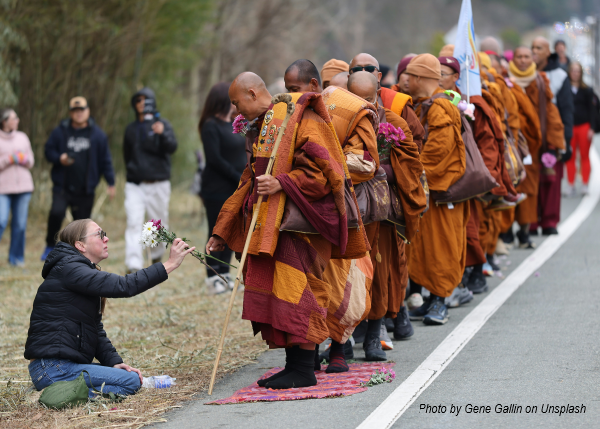
I followed the progress of the Buddhist monks on their Walk for Peace that began in October in Fort Worth, Texas, and concluded on February 10th in Washington, D.C. They walked 2300 miles promoting peace, compassion, and nonviolence throughout their pilgrimage, on sunny days, rainy days, and on cold and snowy winter days. I made it a point to pray for them and with them each day. I wish, however, that I could be more like them.
We are living in a time of fear, worry, and anxiety. For the first time in our nation’s history, many people are afraid that the nation that Abraham Lincoln described as “of the people, by the people, for the people,” is in danger of disappearing. I, along with many others, feel a deep sense of fear, loss, and even anger.
Over the years, I have heard that the phrase “be not afraid” or “fear not” appears 365 times in the Bible, one for each day of the year! This may be an inspiring claim, but it is not accurate. The phrase “fear not!” (or equivalent translations) appears only about 100 times in the Jewish Scriptures, and about 45 times in the New Testament. The total is slightly higher if we include positive phrases such as “be at peace” or “rest in God.” At times like this, however, we wonder if there is really any way to maintain a sense of inner and outer peace, as the monks did on their Walk for Peace. The good news is that there are some things we can do.
Here are a few ideas:
- In the gospel of John, Jesus says, “Peace I leave with you; my peace I give to you. I do not give to you as the world gives. Do not let your hearts be troubled, and do not let them be afraid” (14:27). The word Jesus would have used for peace is Shalom (שָׁלוֹם). In Hebrew, shalom is a broad cultural and spiritual concept. It embodies not only the absence of conflict but a deep sense of wellness and wholeness, as well as a deep sense of calm and harmony within oneself.
To find that kind of inner peace, studies show that it helps to seek peace in the natural world. Take a walk in the woods, along a river, or on the lake shore, or just sit and watch the sunset or a waterfall. Spiritual sages and saints of all religions recommend walking or meditating in natural settings to regain balance and reconnect with nature and the Holy. If the weather or physical health prohibit being outside in nature, visit an art museum, a planetarium, or watch one of the beautiful videos paired with relaxing music available on YouTube. - Psychological research consistently points out the damage to our psyche and emotions from too much time listening to or watching negative news reports and negative social media posts. Take a news and social media vacation for a while to help regain a sense of peace.
- Regular meditation or contemplative prayer is also a proven and powerful way to reduce anxiety, fear, and worry. You don’t need to learn a specific meditation technique, although that can be helpful, as well as connecting you with like-minded people also seeking peace. But for now, find a quiet place and take a deep breath into your belly and exhale through your mouth. Do this for about five minutes a day, or better, a couple of times a day. Adding a simple prayer, like “I inhale peace and calm. I exhale fear and anxiety,” can add to the effectiveness of this practice.
- Psychiatrist and WWII concentration camp survivor, Viktor Frankl wrote, “We who lived in concentration camps can remember the men who walked through the huts comforting others, giving away their last piece of bread. They may have been few in number, but they offer sufficient proof that everything can be taken from a man but one thing: the last of the human freedoms — to choose one’s attitude in any given set of circumstances, to choose one’s own way” (Man’s Search for Meaning).
One way to “choose one’s attitude” is to keep a daily gratitude journal. Each day, write down something you appreciated or made you smile. This will also help to cultivate a positive and peaceful mindset. - Another way to maintain or cultivate inner peace is to surround yourself with harmonious people. You become like the people you spend the most time with. If you mostly hang around angry, frightened people, you will be angry and fearful. Wendy, my wife, and I have protested in support of our democracy and against the cruelty of ICE agents. Some in attendance yell out, swearing in anger, which is understandable. But as both a retired psychologist and a priest, I believe it is healthier to join one of the singing protests or be like those Buddhist monks on their Walk for Peace. In every environment, there are people we can choose to associate with over others. Strive to be in the company of peace-loving and hopeful individuals. Remember what Jesus said, “Blessed are the peacemakers, for they shall be called the children of God” (Matt 5:9).
I find myself moved by the words from Sheriff David Decatur of Stafford County, Virginia:
We were honored to welcome a group of Buddhist monks and their dog, Aloka, on their 2,300-mile ‘Walk for Peace.’ Their journey, centered on the simple yet powerful goal of promoting peace, came into our county across the Chatham Bridge and passed directly through our community, and it left a lasting impression. What made this moment especially meaningful was the reminder that, regardless of our spiritual backgrounds, beliefs, or traditions, there is one common thread that runs through us all. That common thread is a shared desire for peace… peace in our hearts, peace in our homes, peace in our families, peace in our communities, and peace in our world. May this experience inspire us to continue choosing kindness, understanding, and compassion in our daily lives. Even small acts of kindness can ripple outward in powerful ways and make a difference in the lives of others.
The Taoist sage Lao Tzu tells us that “The longest journey begins with the first step” (Tao Te Ching, 64). None of us will likely be going on a 2,300-mile walk for peace like the Buddhist monks did. But each of us can cultivate inner and outer peace with a first step, and one physical or figurative step at a time. We can cultivate inner peace by spending more time focused on our breathing and our words during these challenging times.
During the Holy Liturgy, the priest says, “Peace be with you,” and the gathered respond, “And with your spirit” or “And also with you.” We exchange a sign of peace with each other. Do this mindfully, truly giving and receiving the shalom — the peace of Christ and Divine Love.
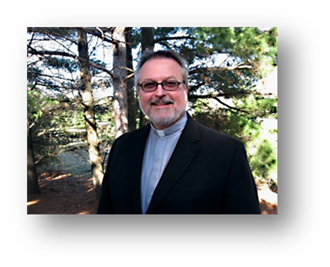
The Reverend Father Yanchy Lacska, PhD, is an ordained Orthodox-Catholic priest, an interfaith minister, and a professed member of the Lindisfarne Community. Reverend Lacska has led retreats and workshops internationally and worked as a university professor, psychologist, and hospital chaplain. He is the author of Finding the Way—The Life of Seeker.