
Autumn Equinox Musings by Rev. Yanchy Lacska, PhD
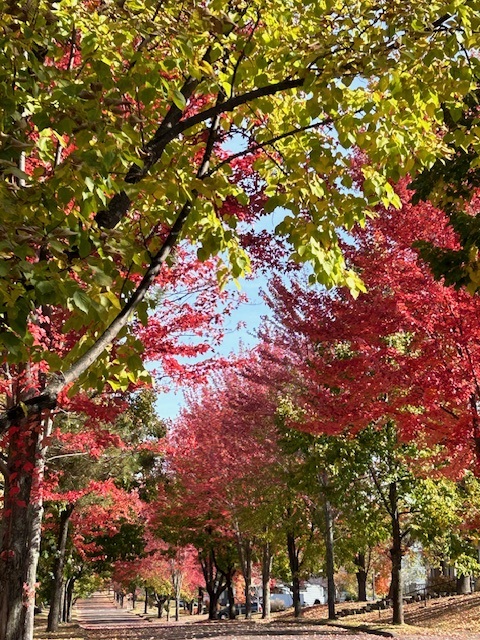
This year, the autumn equinox falls on September 22nd at 7:05 PM. It is a moment in time when the Sun crosses the great circle of the celestial equator, and there is a moment of equal day and equal night. After that brief point in time, the days slowly become shorter than the nights as our Sun continues to rise later and night arrives earlier until the winter solstice, when the daylight slowly increases again.
The autumn equinox is rich in symbolism and meaning around the world. According to cultural historian Eleanor Chang, the September equinox is a liminal time that presents a unique energy, making it particularly significant for spiritual traditions. Archaeologists have discovered that numerous ancient religious structures align with the autumn equinox: The Great Sphinx at Giza, Egypt; Machu Picchu in Peru; Chaco Canyon in New Mexico; the Knowth Passage Tomb overlooking the River Boyne in County Meath, Ireland; and several others.
For the Jewish community, this is the time of Rosh Hashanah, the Jewish New Year. This sacred time is a period of introspection, renewal, and setting intentions for the year ahead. For many Anglican Churches in England, the autumn equinox is also celebrated with a special Holy Eucharist. When my wife, Wendy, and I were in the Cotswolds during the autumn equinox, the local church was decorated with fall harvest bounty for the special equinox service and celebration.
My Chinese qigong teachers celebrated the Mid-Autumn Festival, also known as the Moon Festival, on the full moon closest to the equinox. The Mid-Autumn Festival is one of the oldest and most important holidays and celebrations in Chinese culture that celebrates unity, completeness, and honoring the ancestors with family reunions and a lantern festival.
The Chinese Taijitu or Yin Yang is one of the key symbols of Daoist philosophy. In the West, we usually interpret it as symbolizing light vs dark, good vs evil, two opposing forces, and the dualistic nature of existence. But this is not how the Chinese see yin and yang. It is not about opposing forces. Yin is not about darkness as in the Dark Side of the Force of Star Wars. It is night, winter, rest, stillness, the moon, reflection. Yang is not about the “light” representing goodness; it is day, summer, wakefulness, movement, the sun, and action. Nothing is fighting anything. Yin and Yang are complementary energies that work together to create harmony and balance. The I Ching says, “When the sun reaches noon, it begins to set. When the moon becomes full, it begins to wane. One Yin, one Yang, this is the Way.”
Well-known Wisconsin author Parker J. Palmer wrote, “In a paradox, opposites do not negate each other—they cohere in mysterious unity at the heart of reality. Deeper still, they need each other for health, as my body needs to breathe in as well as breathe out.” So, the balance of the equinox is really about harmony.
Another worldwide symbol of this balance and harmony is the equilateral or equal-armed cross that can be found on relics dating back nearly 5000 years. These crosses have been found in Middle Eastern, Greek, Scandinavian, Native American, and Celtic artwork and reliquaries. Christians use it as a symbol of the crucifixion of Jesus, but Celtic Christians also saw the equilateral cross as a symbol of Christ’s bringing back harmony between the Divine and humanity and within our own humanness and the divine spark within. Wearing an equal-armed cross, like the Benedictine cross the sisters here at St Scholastica wear, can be a meaningful reminder that we are “participants in the divine nature” (2 Peter 1:4).
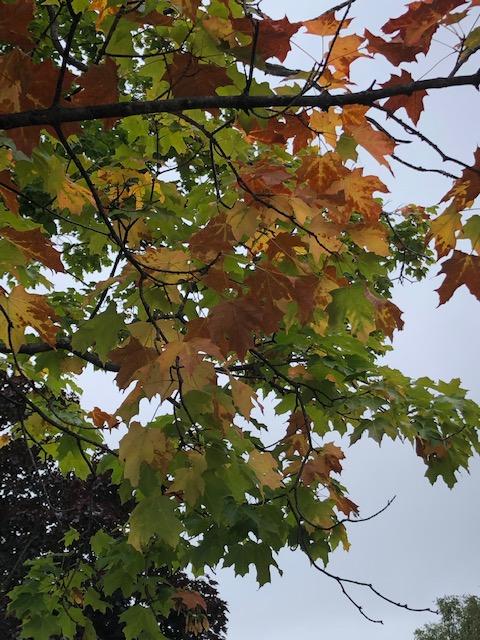
The autumn equinox is the turning point when summer officially ends, and autumn begins here in our Northern Hemisphere. Just as the trees shed their leaves, autumn invites us to shed what is no longer helpful or life-giving, such as harmful habits, behaviors, and beliefs, and hurtful relationships that keep us out of balance and harmony within ourselves, with other people, the natural world, and with God.
On the first afternoon of Rosh Hashanah, it is customary for Jews to go to a body of water and perform the Tashlich ceremony in which they ceremonially cast small pebbles representing their sins or that which they wish to drop from their lives into the water. This ceremony ends with reading the last verses from the prophet Micah (7:19), “Adonai will take us back in love; will cover up our iniquities. and will cast all our sins into the depths of the sea.” For Catholics and Orthodox Christians, this could be a gratifying ceremonial letting go as an adjunct to the Sacrament of Reconciliation, or by itself.
An old colleague of mine used to get sad whenever autumn came around. “Everything’s dying,” she told me once. But I do not see death in the coming of autumn. Instead, I see a great burst of energy before the arrival of winter, like a brilliant and colorful sunset before nightfall.
I see the promise of rebirth. We all know that autumn will succumb to winter, but winter will also yield to spring, spring to summer, and summer, once again to autumn, in a great unending cycle that is the natural order. It lives in our bones, in the very fiber of our beings. In some sense, my colleague was right about autumn; everything is dying. But everything is also being revitalized, remade, reborn. Thomas Merton once said that happiness is balance and order and rhythm and harmony. May this autumn equinox bring you a moment of balance as we prepare for the dark and cold months ahead and reflect on the harmony, order, and rhythm of the seasons.
I end these musings with an excerpt from Holidays and Holy Nights by Christopher Hill that sums up the coming autumn harmony:
Savor the word fall. At this time, we watch the fall of the reign of summer, a great triumph moves deep into a darkness full of danger, promise, and mystery. We pass through a wild night of apparitions into a quiet that grows deeper until it is infused with the lights of candles and stars. Time narrows down until it comes to its turning point, as all creation holds its breath in the silent night and waits for the entry of something new and unimaginable.
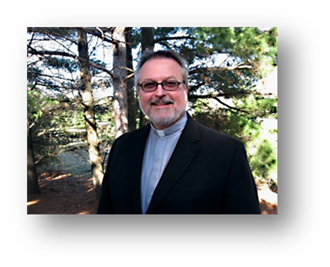
The Reverend Father Yanchy Lacska, PhD, is an Orthodox-Catholic priest, an interfaith minister, a pastoral counselor and spiritual director, who has worked as a psychotherapist, college professor, hospital chaplain, and is a qigong teacher and healer. He is the author of Finding the Way, The Life of a Seeker, published by Wisdom House Books.